










Draghead Deflectors
Reducing entrainment risk during hopper dredging.
Draghead Turtle Deflectors
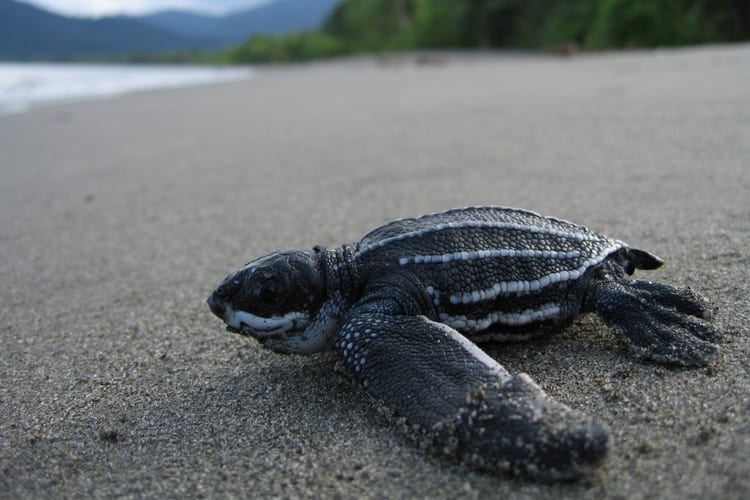
Draghead turtle deflectors are rigid, V-shaped steel plates mounted in front of trailing suction hopper dredge dragheads. They are designed to move sea turtles away from the draghead before the animals can be drawn into the suction system. Deflectors have been required equipment on USACE hopper dredges operating in SARBO and GRBO areas since the mid-1990s.
Development of the modern deflector followed a significant event during 1980 maintenance dredging at Canaveral Harbor, Florida, where 71 sea turtle takes were documented. After early prototypes proved unsuccessful, the USACE Sea Turtle Research Program at the Waterways Experiment Station (WES) - now part of ERDC - conducted coordinated research from 1991 to 1994. The program worked with the Marine Design Center in Philadelphia, the Jacksonville District, and industry partners, including George Banks of Banks Dredging (Banks and Alexander 1994/1995), to develop the modern rigid V-shaped deflector.
Hydraulic flume model tests found that the rigid V-shaped design effectively deflected model turtles when the draghead remained firmly on the bottom and the leading edge was angled to push a shallow wave of sand ahead of it, physically displacing resting turtles before suction contact. In July 1993, additional testing at Fort Pierce, Florida, used model turtles to compare three draghead configurations. A bare California draghead entrained 14 of 28 model turtles, or 50 percent; a chain-deflector configuration entrained four of 34, or 12 percent; and the rigid V-shaped deflector entrained only two of 39, or 5 percent, and damaged none.
Current Specifications
Performance requirements are described in the ODESS Sea Turtle Deflector Checklist for Hopper Dredges (Version 5, July 2016). The checklist includes requirements for the leading-edge angle of 90 degrees or less (operating tolerance +0/-4 degrees); plowing depth of at least 6 inches (~15 cm) into the substrate, with ERDC TR-18-4 specifying a 15-20 cm target burial; rigid aft attachment (hinged or trunnion) and an adjustable forward attachment with a stop; the maximum opening between the draghead and deflector of 4 by 4 inches.
Before dredging begins, each project requires approval of a structural-design submittal. Contractor Quality Control personnel then perform a "paint test" to verify that the deflector reaches the required plowing depth at the approved approach angle. Other designs - including Turtle-Excluder Skirts for uneven bottoms, articulated visor deflectors, and turtle-tickler chains tested on the Essayons in Hawaii - may supplement the rigid V-shaped deflector but do not replace it as the program standard.